

Summary:
Marketing strategies have historically relied on broad, imprecise targeting methods, often missing the mark on connecting with the right audience. The advent of big data and AI aims to bridge this gap by identifying high-intent prospects through advanced data analysis and behavioral pattern recognition. Effective use of AI can significantly enhance targeting efficiency, reducing customer acquisition costs by focusing on the 3% of the market actively ready to buy. However, the success of these systems hinges on the quality of data used, as inaccurate data can undermine campaign performance. As AI becomes integral to marketing, the challenge lies in leveraging these tools effectively rather than relying on outdated, broad strategies.
Most writing about "Big Data and AI" in marketing follows a predictable pattern.
Repackage a white paper. Add a Venn diagram. Sprinkle in some statistics from a study nobody can find. Conclude that AI is transformative and you should probably do something about it.
What's missing from almost all of it is the actual mechanics — what these systems do, how they work, where they break down, and what the numbers look like when you test them against reality instead of a slide deck.
This is the version with the mechanics included.
The Problem Nobody Wants to Admit
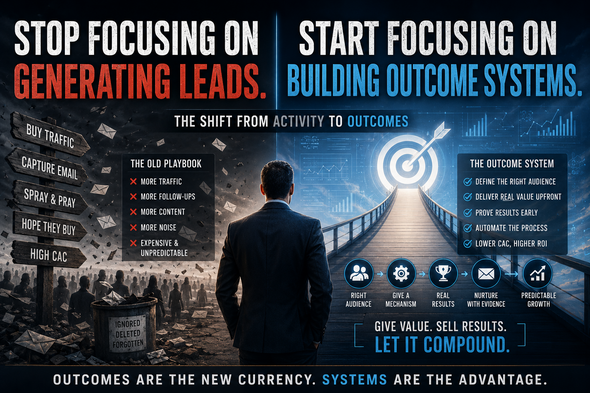
Finding quality leads has always been the game. And for most of marketing history, it was a numbers game dressed up as strategy.
Buy a list. Mail to it. Pray.
Run ads to broad audiences. Hope someone converts.
Cold call until your ear falls off.
The sophisticated version of spray-and-pray was still spray-and-pray — just with better spray cans.
Here's the truth underneath all of it: most marketing never actually knew who it was talking to. Demographics. Zip codes. Job titles. Educated guesses dressed up as targeting.
That's not an audience. That's a census report.
The real problem was never reach. It was identity. Marketing couldn't connect a person's behavior — what they were reading, searching, clicking, considering — to a real human being who could then be reached with the right message at the right moment.
That gap is what big data and AI were always meant to close.
How the Systems Actually Worked
Around 2015, a shift became visible.
Data was becoming the asset. Not traffic. Not clicks. Data.
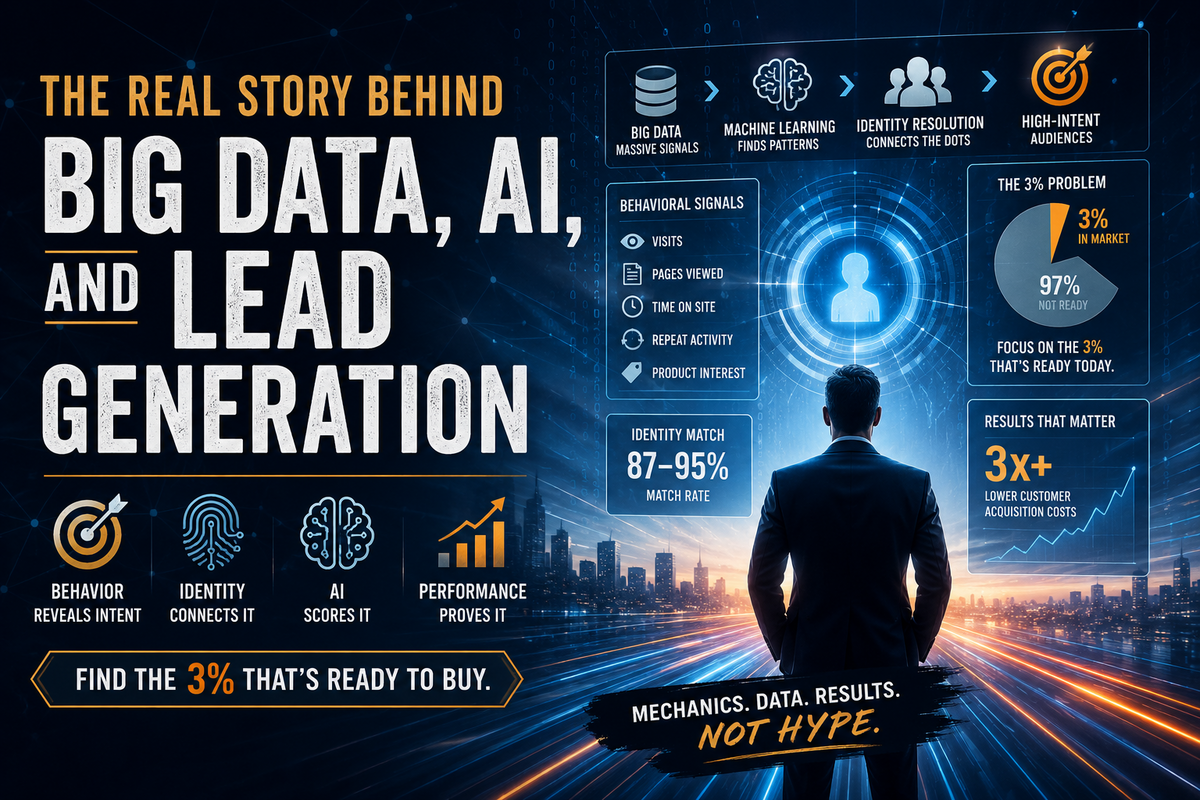
Agencies and advertisers were sitting on massive files of hashed customer records — emails encrypted with MD5, SHA-1, SHA-256 — with no practical way to make them useful for targeting. So a simple service got built: HashMatcher. Upload hashed records, receive matched clear-text emails. It launched with a 50% match rate. Within six months, through testing and data refinement, that pushed to 87–95% — consistently.
Without a dollar of marketing spend, that product grew to $10,000–$15,000 in monthly recurring revenue. The demand was already there. It just needed a tool that worked.
That was the warm-up.
The next system — HashTargetr — placed a small tracking pixel on a client's website. When visitors arrived, behavioral signals were analyzed in real time: time on site, pages viewed, repeat visits, specific products or categories browsed. Identity resolution matched a significant percentage of those anonymous visitors to hashed email identities and began building profiles around them.
No PII handed to the client. Everything operating through hashed identities. Privacy-first by architecture, not by afterthought.
The result: advertisers could build custom audiences from their own high-intent website visitors and feed those audiences into Facebook and Google's algorithmic models as seed data. The look-alike audiences those platforms generated from quality seed data dramatically outperformed anything built on generic demographic targeting.
In many cases, advertisers cut customer acquisition costs by 3x or more — not by spending more, but by feeding the algorithm better data.
That's the real intersection of big data and performance marketing. Not the concept. The mechanics.
The 3% Problem
Traditional lead generation finds people who match a profile. Data-driven lead generation finds people who are actively in market right now.
That difference sounds subtle. It's enormous.
One approach guesses at intent. The other measures it.
At any given moment, roughly 3% of any market is actively ready to buy. The other 97% might buy eventually — but not today. Most marketing budgets are aimed at the 97% because that's where the volume is. The real game is identifying the 3% — the people researching, comparing, pricing, returning to a site for the third time this week.
Those people don't need to be persuaded. They need to be found and reached before a competitor gets there first.
Big data makes that identification possible. AI makes it fast enough to act on.
What AI Actually Does — And What It Doesn't
When SmartPath-AI was built — a unified campaign orchestration platform connecting identity resolution, data enrichment, and multi-channel activation — it was named with "AI" in the title because that's where the industry was heading and the positioning needed to reflect it. But the underlying technology was machine learning regression models. Pattern recognition. Behavioral signal analysis.
Not magic. Not sentient software. Mathematical models trained on behavioral and transactional data to identify patterns that predict high-intent prospects.
In plain language: AI analyzes behavioral signals — what someone searched, how long they spent on a page, how many times they visited, what they clicked — and identifies patterns that correlate with purchase behavior. It then scores and ranks the audience. The people at the top of that score aren't guaranteed buyers. But they're demonstrably more likely to convert than a cold audience built on guesswork.
That's a real, measurable improvement in targeting efficiency. Not hype.
What AI doesn't do is replace strategy, offer quality, or messaging. It amplifies what's already there. Feed it a strong offer aimed at a qualified audience and it becomes a multiplier. Feed it a mediocre offer aimed at a cold audience and you've just failed faster, and at scale.
AI is a force multiplier. It is not a substitute for thinking.
The Part Nobody Tells You About Data
Here's where the industry has a credibility problem worth examining directly.
A test file of about 2,000 people — verified records of friends, family, and known contacts whose correct information could be confirmed with absolute certainty — was run through the biggest, most respected data providers in the identity resolution space. The gold standard companies. The ones with the most confident match-rate claims in their marketing.
Most came back at 30–40% accurate.
Thirty to forty percent.
Against verified ground truth. From the best providers available.
That's not a rounding error. That's a structural problem. And it explains why so many campaigns underperform in ways that are hard to diagnose from the front end — the targeting looks right, the audiences look qualified, but the fuel is contaminated and the dashboard doesn't know it.
The quality of your data is the ceiling on your campaign performance.
Better data doesn't just improve targeting. It improves every downstream system that feeds from it — email sequences, retargeting audiences, look-alike models, lead scoring, CRM follow-up. Garbage in, garbage out, at scale, with a paid media budget attached.
Where This Is All Going
The "AI is coming" moment is over. AI is here, operational, and actively widening the gap between marketers who use it as a serious system and marketers who use it as a content generator.
The real opportunity — now finally accessible without building custom data infrastructure from scratch — is this:
Connect behavioral intent signals to real identity. Score that identity against purchase behavior patterns. Activate the highest-intent segments across every channel simultaneously, with messaging calibrated to where each person is in their buying cycle. Measure the output in one number: cost of acquisition, moving down.
That's not a software pitch. That's a description of what the best-performing customer acquisition systems are doing right now.
The covered wagon versus the Tesla moment has already passed. The question isn't whether to use AI and data in lead generation. The question is whether the understanding is there to use it well — or whether the plan is to keep spraying and praying with a more expensive spray can.
The tools available today are more powerful than anything that had to be engineered from scratch a decade ago — at a fraction of the cost, with none of the custom development.
The playing field has never been more level. The question is who shows up with a real game plan.
The Chief Rainmaker
When You Want Rain
Gil Ortega is the founder of Profit Worldwide, Inc. and the creator of the Chief Rainmaker brand — a San Diego-based marketing strategist focused on customer acquisition, audience engineering, and AI-powered growth systems. He is the author of Give Value Sell Results: Building Predictable Outcome Systems in the Age of AI.
Read more at ChiefRainmaker.com