

Summary:
AI has transformed marketing by commoditizing content creation, shifting the focus from effort to outcomes. Traditional strategies like lead generation now require demonstrating tangible results rather than just providing information. Success lies in creating systems that deliver real value and build trust through consistent, proven results, making businesses the obvious choice for their target audience.
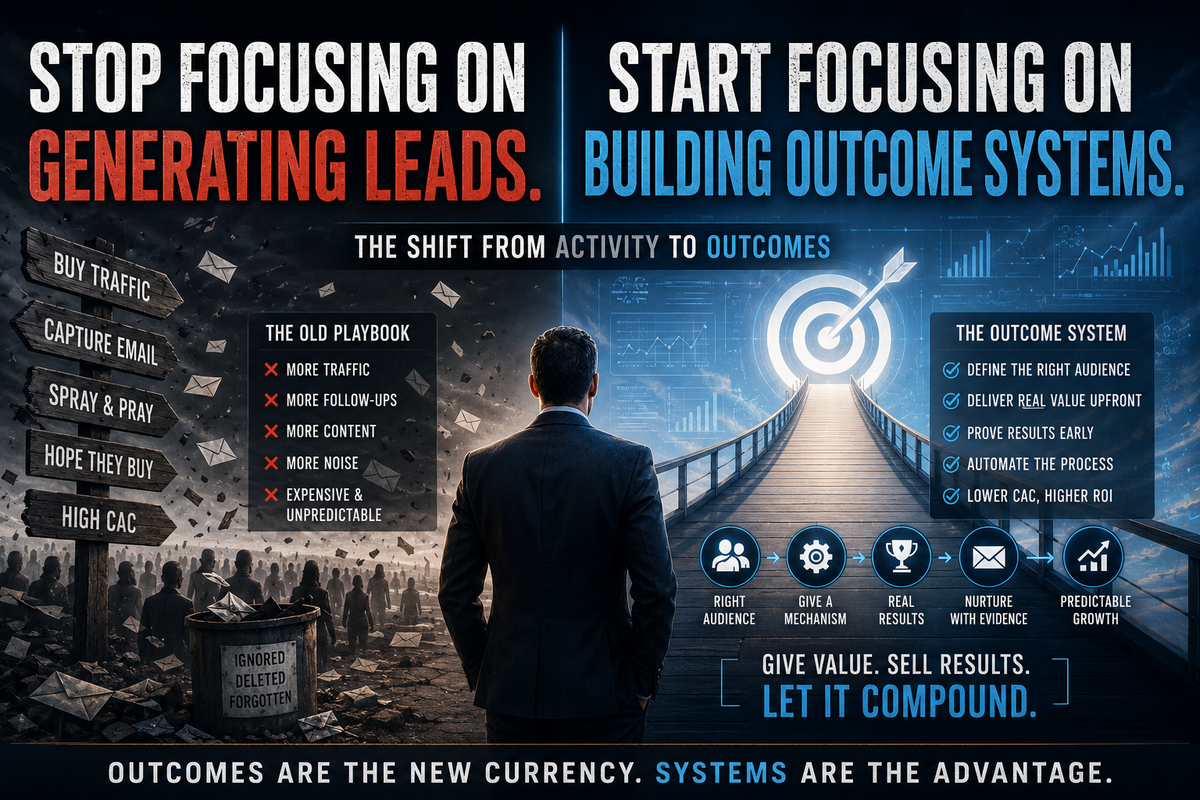
Oh sure, it's wearing new clothes. There's an AI badge pinned to the lapel, some automation buzzwords stitched into the lining. But underneath? Same strategy. Buy traffic. Capture email. Spray follow-up until they buy or unsubscribe. Wonder why your cost per acquisition looks like a mortgage payment.
Every wave rolls through marketing like it's the next coming of fire: direct response, SEO, social media, paid ads, funnels, "high-ticket everything," influencer culture, automation, NFTs (bless their hearts), and the endless parade of tactics that work brilliantly — until everyone uses them, at which point they work like a screen door on a submarine.
But here's what's different about AI: it didn't just hand you a new tactic. It changed what the market actually values. And most marketers are still treating it like a really fast content intern.
So let's talk about what's actually happening — and what to do about it.
The Economics Changed. The Playbooks Didn't.
When production becomes cheap, the world stops paying for effort and starts paying for outcomes.
Think about what AI has commoditized in the last two years: writing, design, research, ad copy, funnels, scripts, landing pages, email sequences, entire content strategies. All of it now costs roughly what it costs to ask a question. Which means every one of your competitors now has access to "good" — instantly, cheaply, continuously.
When everyone can produce "good," good stops being impressive.
A polished website is no longer proof of capability. A well-written email is no longer a differentiator. Professional-looking ads are table stakes. The bar for appearing credible has never been lower, which means the bar for being trusted has never been higher.
This is the part that should change how you think about lead generation at a fundamental level.
Old lead generation asked: How many people can I reach?
New lead generation asks: How clearly can I demonstrate a real win before I ask for anything?
The leads come when you answer the second question well. The rest is just expensive noise with better production values.
"Give Value" Has Been Lying to You
If you've spent any time in the internet marketing ecosystem — and if you're reading this, you probably have the scars — you've heard "just give value" so many times it's become the equivalent of "have you tried turning it off and on again?"
It's not wrong. It's just incomplete. And in 2026, incomplete is the same as useless.
Here's the problem: in the knowledge economy, "giving value" meant sharing information. Tips. Guides. How-tos. Free PDFs that 4% of people opened and 0.3% of people finished. We called this "nurturing." What we were really doing was stalling.
Information is not scarce anymore. You can get a passable answer to almost anything in thirty seconds. The market doesn't reward people who know things — it rewards people who can create progress.
Progress is scarce. Progress is what people pay for. Progress is what people remember.
So here's the updated definition: giving value means giving a mechanism that produces a real result. Not a pep talk. Not five tips. A thing that actually does something useful for someone in one sitting.
A prompt that generates exactly what they needed. A framework that turns their messy problem into a clear path. A system that keeps a promise on repeat without requiring them to summon superhuman willpower every Tuesday.
That's not content. That's execution delivered as generosity. And when you give someone a real win before you ask for anything, you don't have to convince them you're credible. They already experienced it. You delivered them into belief instead of arguing them into it.
The mechanism is the marketing. Give Value. Sell Results. Let it compound.
The Practical Part: What a Real System Looks Like
Here's where most advice falls apart — it stays in the philosophy lane and never actually tells you what to build. Let's fix that.
A predictable lead generation system isn't complicated. It's a repeatable process that reliably produces a measurable result for a specific person. Think restaurant kitchen, not motivational poster. A great restaurant doesn't hope the meal turns out. It has a recipe, a station, a timing sequence, and quality control. Every time. That's why people come back.
Start with a real audience, not a demographic.
"Small business owners" is not an audience. "Female founders in the health and wellness space who have an email list under 2,000 and are losing sleep over inconsistent monthly revenue" is an audience. The tighter you define the person and the problem, the higher everything converts — leads, calls, closes, referrals.
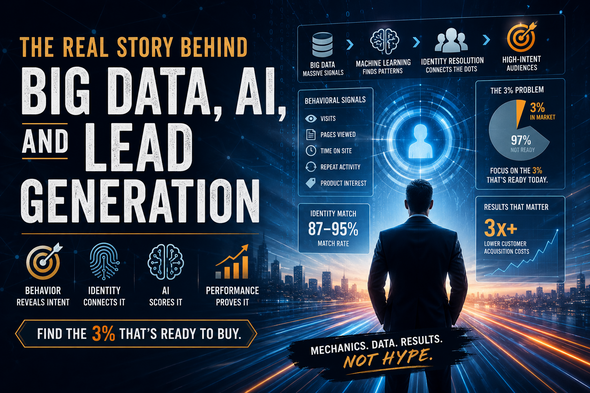
Audience systems that cut advertiser acquisition costs by 3x aren't doing anything exotic on the campaign side. The ad creative is the same. The platforms are the same. The variable is audience quality — narrower, more accurate seed data going into algorithmic models produces dramatically better output. Better input, better output. Every time.
Give a mechanism, not a magnet.
Your lead magnet is probably a PDF that your prospect downloads, doesn't read, and eventually uses as evidence that their inbox is a digital landfill. Said with love, because plenty of them have been built over the years.
Replace it with something that produces a result in one sitting. A short diagnostic. A fill-in-the-blank template that outputs something real. A prompt chain that actually does a thing. The goal is for your prospect to finish it and think "well that was genuinely useful" — because that thought is worth more than any clever headline you could write. It's proof. And proof is the new persuasion.
Build follow-up sequences around evidence, not urgency.
Most email nurture sequences are structured like this: warm email, warmer email, pitch, softer pitch, "last chance" pitch, silence, repeat three months later.
The problem isn't the frequency. It's that every email is trying to convince instead of trying to demonstrate.
Flip it. Every email in your sequence should stack another piece of evidence. A result someone got. A story about a problem that got solved. A before-and-after that your prospect can see themselves in. You're not building pressure — you're building a case. By the time they're ready to buy, they've already convinced themselves. Your job at that point is just to not get in the way.
Measure where the system is leaking.
Most advertisers watch their front end like a hawk and ignore their middle funnel entirely. It's a pattern that quietly destroys companies with genuinely great products — the lead volume looks fine, but somewhere between opt-in and conversation, people are evaporating and nobody knows why.
Every stage of your system needs a number. Opt-in rate. Open rate. Click rate. Lead-to-call booked. Call-to-close. Not to obsess over dashboards, but to know which domino to push. One meaningful fix to the right stage of a system beats three new traffic campaigns every single time.
What AI Is Actually For
AI is not a content machine. Or rather, using it only as a content machine is the most expensive way to waste your leverage. It's like buying a Ferrari to sit in traffic. Technically in motion. Not actually going anywhere.
Here's what AI is genuinely exceptional at in a lead generation context:
Reading behavioral intent. AI can process patterns that humans can't — what content someone engages with, how long they stay, how many times they come back, what sequence of actions correlates with actual buying behavior. The behavioral signal analysis that used to require a full data engineering team is now increasingly accessible to solo operators willing to actually set it up.
Personalization that doesn't feel like a mail merge. Real personalization — messaging that adapts to where someone is in their buying cycle, sequences that branch based on actual behavior — is now buildable without an enterprise budget. The difference between "Hi First Name" and "I noticed you came back to the pricing page three times this week" is the difference between a stranger and someone who was paying attention.
Follow-up that doesn't require a babysitter. A platform built specifically to alert businesses when dormant leads returned to market revealed a hard truth: companies would get the alert, make one call, leave a voicemail, and stop. One touch. The technology worked perfectly. The follow-up process was a disaster. AI-powered automation solves the human reliability problem — not by spamming people into submission, but by maintaining consistent, intelligent presence across multiple channels until someone raises their hand. The system keeps the promise when the team's attention has moved on.
The Trust Angle Nobody's Talking About
AI has made it easier than ever to fake authority, testimonials, screenshots, case studies, and credentials. Buyers know this. They've been burned enough times that they're now professionally skeptical.
This is actually fantastic news — if you build correctly.
When the market is drowning in noise, the person who consistently delivers real wins becomes a lighthouse. Not because they're louder. Because they're true. Small, consistent, demonstrable outcomes build more trust than any amount of slick positioning ever could. Quiet, repeatable, proven competence is about to become wildly profitable.
The operating code that runs through all of this: Give Value. Sell Results. Deliver. Repeat. Compound.
Give a real win. Let the win build belief. Let belief become trust. Let trust generate a sale. Deliver on the promise. Turn the delivery into proof. Use the proof to attract the next person. Repeat until the flywheel is doing most of the heavy lifting.
Note that last word: flywheel. Not funnel. A funnel requires constant new volume at the top to produce anything at the bottom. A flywheel gets easier to spin the longer you run it. One is a treadmill. The other is a compounding asset.
The whole point of building a business — as opposed to just surviving one — is to eventually own a flywheel.
The Shortest Version of This Post
You don't need more leads. You probably need a better system for the leads you already have.
One audience. One specific problem. One mechanism that creates a real win before you ask for anything. One evidence-based follow-up sequence. Measure what's leaking. Fix the leak. Scale what's working.
That's it. Everything else is decoration.
The future of lead generation isn't about reaching more people. It's about becoming the obvious answer for the right people — because your outcomes already spoke before you said a word.
Build the system. Let the system sell.
The rest follows.
The Chief Rainmaker
When You Want Rain
Gil Ortega is the founder of Profit Worldwide, Inc. and the creator of the Chief Rainmaker brand — a San Diego-based marketing strategist focused on customer acquisition, audience engineering, and AI-powered growth systems. He is the author of Give Value Sell Results: Building Predictable Outcome Systems in the Age of AI.
Read more at ChiefRainmaker.com